Thursday, June 13, 2013

More garden antics

It has been a frantic week. We are so late on the garden. So I have been spading and then spading some more. Agriculture is a labor-intensive activity. Today John and Fluffy went to the "sanderia"  i.e a place where we can get sand. Free. I am adding sand to my garden, which is mostly silt kindly deposited by the Susitna glacier quite some time ago. It is very poor soil. So I add sand. This helps the clumping tendency of silt. I add manure, and of course lime (usually; but do not lime the potatoes!). John also kindly covered the greenhouse. This year I am going backward. I usually do the transplants, then seeding, then greenhouse. This year I am doing it backwards.

This afternoon the greenhouse beds are ready to go.

 Our greenhouse is totally homemade, of course. I have mentioned it before. It is prepared for planting and tomorrow (I hope) I plant. Tomatoes, Zucchini, and the rest. I think I've got some cucumbers. All these are greenhouse crops in Alaska.
 
The outside beds have been spaded (oh, the labor... and the weeds). Today I did about half the manuring, tomorrow lime and go. I hesitate to say this but maybe this weekend we can plant.  There are two new rows to be added but that can wait. We are so late. There was no choice in the matter. It was a fiendish spring and we had to wait on it. Agriculture is a chancy business.

One of these days I must do a post on the perils of compost making in Alaska. Not quite like the lower 48.

Wednesday, June 5, 2013

Garden at last!

As I have said before it has been incredibly wet. Our driveway is still iffy in spots. The garden was a morass. Usually Memorial day weekend is planting time, but not this year. You never realize how weather-dependent agriculture is until you do it yourself.

But Monday I went out there and tested. It was OK.  Really a bit too wet, but that has its upside: the weeds come up quite easily. The first crop was already there: the dandelions. Actually they are very good for you. The leaves can be added to salads when they are young; they give the salads a real boost. After that, you have to cook the leaves; they are bitter but vitamin-rich. The roots make a coffee substitute, but I haven't tried that one yet.

So I took the spading fork and went to work. The objective is to remove the  weeds and break up all the clumps. One could, of course, use a tiller. But tillers are rather violent creatures and I prefer to do this by hand, although it is backbreaking labor.
I have four rows. I have done two and a half. They still need to have manure spread on them. Maybe some sand to increase the "tilth" because our basic soil is 100% silt from the Susitna glacier. Maybe some other organic matter will be added. Then there's the small business of planting. We are two full weeks behind time. No remedy. We will have to trust for the best. It has been an unusual spring. I don't try to keep up with the Joneses, but nobody in the village has planted either. And they have been here much longer than I have.

Well, at least today the sun shone for a while. I have my fingers crossed.


Thursday, May 23, 2013

Spring is here. Well, maybe not so much

It has been an extremely long winter. Then again, human memory for climate is short. Perhaps 30 years. I had a professor, long ago. Dr Helmut Landsberg. Prof. Landsberg had actually studied the human memory for meteorological events, such as hurricanes, floods, and even seasonal changes. That's whence I got the thirty year thing. We have a very selective filter, and anything intergenerational escapes it.

But this has been the slowest spring I have seen since I came to Alaska in 1999. Today I did a photo-op on our spring. First thing I did was go out to the garden. It is traditional in Alaska to plant on Memorial day. Not so much, this year. So I did a photo-op on it.
 First thing I did was to go to the garden. First, you can see the snow still on the ground in the background. Second, the garden is muck. I sank in 3 cm. No way I am planting this weekend. What fell effects this may have on my internal economy remains to be seen. Short growing season!
 
 Next we have the driveway. It is clear, but you see that snow patches linger on. Substantial snow patches. Bummer! I have never seen that much snow on the ground this late. Onwards.
Basargin loop, on which I live -- and have to maintain -- is a morass. It can be passed with 4x4 but is very iffy. But there is worse. There is the Basargin Road tank trap, a photo of which appears below.
At least we will have no Panzers coming through any time soon. The tank trap is impassable -- absolutely impassable-- by any vehicle  with less than 30 cm ground clearance.  Holes too deep. This excludes poor Vicky Vitara from making the passage. Notice that the villagers have dumped scrap wood all over the place in a futile attempt to improve things.  Notice the low-clearance car prudently parked on the Goat farm property. Neil is no fool! The only solution I can see is to corduroy the tank trap. One would cut logs to road width and put them down in close contact. This is a major undertaking. It involves chain saws and a lot of backbreaking manual labor, putting the logs in close contact. It is easier to let Ma Nature do the work and dry it out.  That is not happening with any speed.

However, this week I abandoned clocks and did some bicycle repair work.  I now have two functional bikes. This winter, the machine shed collapsed on one of my bikes (the best one, of course) and turned the rear wheel into a pretzel. I salvaged the axle and put it on my second bike, which had a broken axle. So not all a loss, and I am learning a lot about bicycle repair. More later, of course. I hope.


Tuesday, May 14, 2013

Creeping up on a new clock

First of all you should be aware that the wooden clock is alive and well. It is being finished at John's cabable hands. There are a whole bunch of fiddly parts that have to be finished.And there is still the pendulum, and the weight, and the pulleys. Lots of stuff to do. The backbreaking work is over, though.

But until they are finished, I can't work on anything else. So, as I have said before, I am jump-starting my next clock. This is the Isaacs clock.

The real problem with making clocks is making the wheels, i.e. gears. The real problem with making wheels is the wheel cutters. So since my last post I have been obsessed with making cutters, I am following a page which I supplied before, so I will not bore you with the details. I will say that it has been quite difficult. Now you could order these cutters form Mssrs. P.P Thornton in the UK for a modest 40 UKP apiece. Gulp. No. I must make my own cutters.

The cutters in question are described in Dean's pages, which I linked before. THe trouble is actually cutting them. Of course, I am not using "1/8 tool steel" as Dean suggests, because this is Unobtanium in Alaska. So I am using an old lawnmower blade. Very tough stuff.  It resists even my carbide tools. Plus it is an interrupted cut. The lathe tool cuts only sometimes. Since it it made on an eccentric arbor, that is, the center of rotation does not coincide with the center of the tool, it is very difficult even with carbide tools, which is what I am using. I persevered. I learned. Next time I will use my newly acquired angle grinder to rough the thing out. These things are at the extreme limit of the Taig lathe.

In the meantime, I read, on a clockmaking forum, of the equipment of some fellow clockmackers. This included a gentleman with an 18" South Bend lathe. That's about 450 mm swing and would have breezed through the cuts that strained my 55 mm lathe. Wish I had an 18" South Bend. "I like to take big cuts," said the owner.

But eventually, about a week or so later, I wound up with a cutter blank.
This image is a little confusing. There are four holes filled in with JB-weld. They don't count. The ones that do count are really half-holes. Notice the shape of this thing. It is a sort of a square with rounded sides. That is the effect of the eccentric arbor. The rounded sides provide relief.  See Dean's page, previously cited. It took forever to get to this point.

However, we got there. The next stage is to make a form tool to shape the cutter teeth.

This whole thing is unwinding the Industrial Revolution. You need A. But to make A you need to make B. But to make B, you need to make C... and so on.  Either that, or pay Mssrs. P. P Thornton Ltd. forty quid for one cutter. Ouch. I will make my own, and and a very interesting experience, too. A fine fate for a recycled lawnmower blade.

Saturday, May 4, 2013

Fixin' to get ready on a new clock

By now you are well aware of my current obsession with clocks. Our wooden clock is in the capable hands of John, who is finishing my wooden stuff. There is very little left to do on it. Actually there is quite a bit; but it is not difficult. So I have cast around for a new clock. I found the Isaacs Clock. This is a beginner's clock, and I am really the rankest beginner. I found it on the fascinating Dean's website. I am now tooling up for the Isaacs clock.


Lot of stuff there. Look for Dean's clock project. Not the least of the atttractions of this project is that I can do it on my Taig lathe. The original article is under the Yahoo horology group. I went and found the article. It is scan (not always very good) of an article which appeared in Model Engineer, date unknown, by the looks of it.  I downloaded the article, in about nine parts. After a cursory scan, it was immediately obvious that to cut the wheels (gears) on this thing I would need a new dividing plate. I needed 100, 96, and 30 holes. So my first job was to make a new dividing plate.

There is a lot of stuff on making dividing plates. A dividing plate is an indexing device. It allows you to rotate something by a very carefully calculated amount. The big boys use worm and gear dividing heads. This is a very expensive alternative. I use a PostScript program that I wrote long ago to give me a paper template. I paste the template on to the final material. Some people use brass. If I could find it in Alaska at all, I would use it. But it is Unobtainium in Alaska. So I use Acrylic. I have a large supply of some stuff I found thrown away, long ago.  I made the inner ring 60 holes. A very useful set of holes. For 30 holes I use every other hole of the inner ring.

I then paste the template on the acrylic. Cut it to rough shape. Using my faithful Veritas optical center punch (q,g.) , I centerpunch the holes. Then with great care I drill 1.5mm holes in the plate. Hint: keep the paper side up. Else you will get a distorting lens effect, caused by the fact that acrylic is transparent.

Next job. This is complicated. We have to make a cutter for the gear teeth. But in order to make the cutter we have to make a jig to make the cutter. The first part of this jig is the base. Dean, above, used brass. Unobtainable. So I used a scrap piece of steel I picked up. You will not understand this at all unless you look at the article I followed, also at Dean's site.Maybe after you look at it you will still not understand it, but for sure I will not duplicate Dean's crystal-clear instructions.

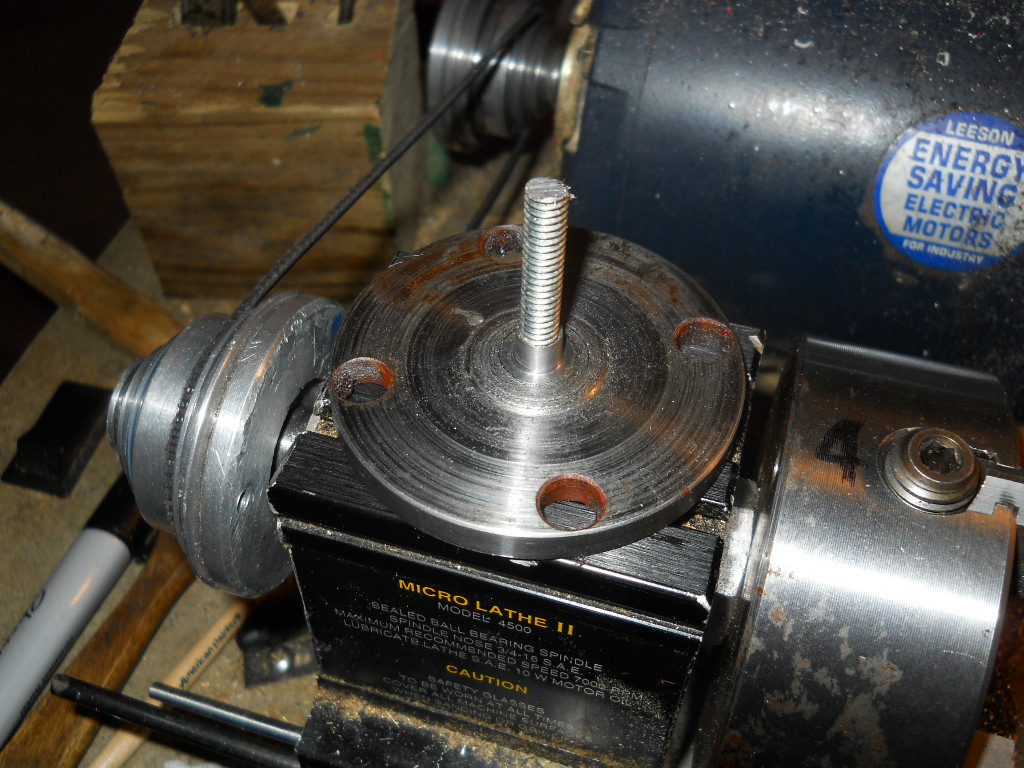
Here I have turned the piece of scrap to a nice round shape. It was not easy. After that, drilled a hole in the middle of it (and each of these steps is quite an oddysey)  and tapped it. Due to the fact we live in Gringo-land I used a 1/4-20 tap, I wish I had 6mm x1 instead, and stuck a piece of threaded rod in it, and put a nut on top of it. The threaded rod and nut are hardware store stuff. Next step a bit harder.

Got to turn down nut thing round. To what diameter? Well, I looked at what was around on the web. Dean pointed me to an article by one Mr Creed, who may be found on the Yahoo Horology group, I believe. In this article, Mr Creed suggested 7mm diameter. Most commercial cutters use this diameter. OK, said I. A fateful decision. Above I have turned the nut down to 7 mm.  The base is complete. Or so I thought.

Never that simple. But that is another post.


Saturday, April 27, 2013

The ground, the ground!

It seems spring has arrived. It was rather coy. It dumped a foot of snow in March, so we had an unusal amount of it around. But "breakup" as they call it in Alaska, seems to have arrived. I know it is breakup when I can see my driveway.
We should not be surprised, but I at least always am. Look! I can see some of the driveway! Behold! I can see the path to the door! We have not beheld this sight since December. The ground is bare. In places. It does seem to be melting. Nights still go below freezing. But we are getting there. Breakup is a frustrating season. Too much snow and slush to bike. Snow quality awful, can't ski. Can't garden. Snow on ground, and it is frozen anyway. Grr. So I have to walk. Trouble is I have taken all walks at least a thousand times. Nothing new here!

Well, there is always clockmaking. It will not be long before I inflict it on you again, so enjoy the respite.

Wednesday, April 17, 2013

Finishing a clock (literally)

The time has come, the walrus said, to speak of many things (Lewis Carrol, The Walrus and the Carpenter). And now we have to put on a spurt of effort and actually finish the thing. Literally. Among the major projects done since my last post, the biggest is the minute work. Clockspeak, of course. In my case this is a misnomer. The Center Wheel revolves at a majestic rate of one revolution per hour. Great thing for a minute hand! But, as you will immediately see, this is not really cool for the hour hand. In one hour, given our 12-hour dials, the hour hand has to go round 1/12 the distance. (12 hours in one half-day). So what to we do? Add more gears, of course. Now I had cut these gears on the bandsaw long ago. But now we have to depth the wheels and pinions.  Clockspeak rears its ugly head again. Remember, big gear is a wheel, small gear is a pinion. Depthing means make them run freely. Book recommends sandpaper. I found a better way. Mr Wilding didn't know about Dremel tools or he would have done this himself. Book published in 2002 or so.
 So I did something I should have done long ago. Live and learn. I measured the aperture between gear teeth, and it is close to or exactly 3mm. I searched my inventory of Dremel tool accessories and found a router bit very close to 3mm. I put the wheel into the Taig and the Dremel into my vertical milling attachment. With this setup I could shave 0.01 mm off the teeth, and shave them I did, running the Dremel at max. Saved hours of work. I used my 60-hole dividing head to position (index) the teeth. Forget sandpaper. It was very nice that these things are 30-tooth gears; my 60-hole dividing plate can handle them easily. Pinions done same way; again they fit my 60-hole dividing plate.

This bit done, the we are almost through the major work on the clock. So the big moment has arrived. The clock was taken apart. If you make a clock, you will soon learn that the fate of a clock is to be taken apart. I handed the clock over to John. He is to make it look pretty. He is very, very, good at that.

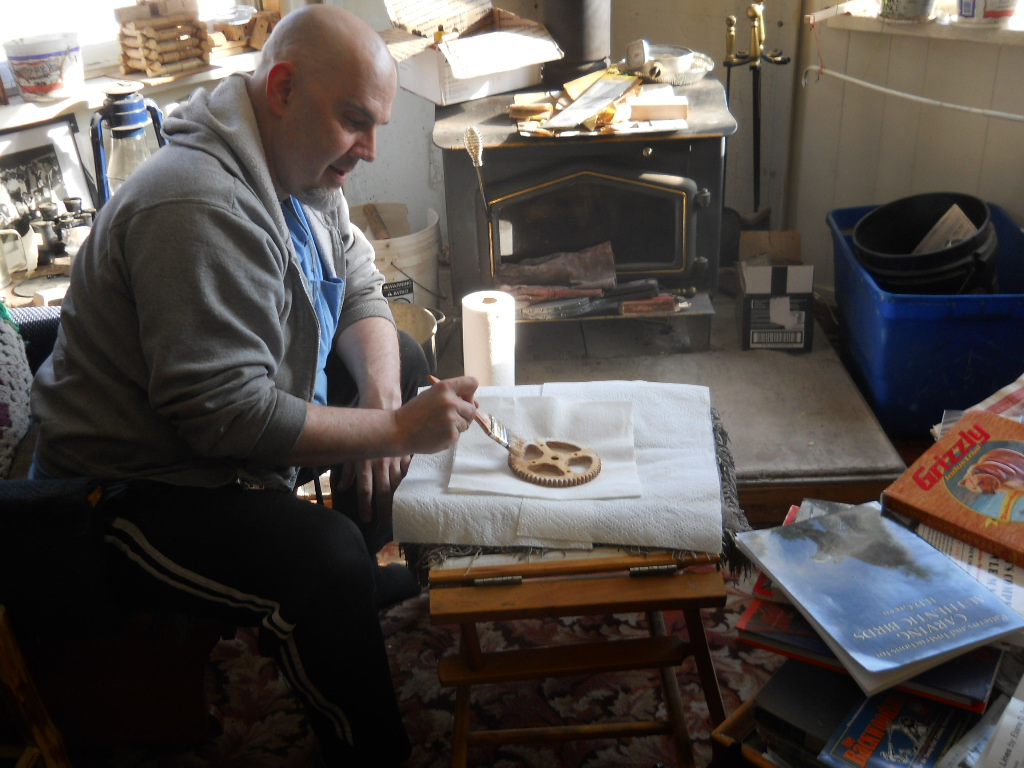
 Gulp. The paper patterns have been sanded off. I feel lost without my paper patterns. But go they must. So John got rid of them. My only spec was that the various wheels should have different colors. Here, John is staining the Center Wheel. Previously he has sanded it. Gone is the paper. Again, gulp.
 The plates look very nice in a much darker color. They have a certain character.
There are many details with which we have to deal. But amazing.  A piece of very cheap plywood turns out a very nice clock.

Endless details. I have to smooth out the escape wheel. I have to make the pendulum...  never mind. Progress is progress.

While all this is going on I am setting up to make my next clock. It will not be a wooden clock. And that is all I will say at this point. But clockmaking is not a hobby. It is an obsession.